
前言#
昨天我们分析了setup如何处理props等,今天我们接着往下分析。
坏蛋Dan:vue/compiler-sfc源码分析学习--part2:如何处理script--day4
感兴趣的大佬可以看下
正文#
今天是分析如何处理script的最后一天了,加油!
生成setup的返回语句#
  // 10. generate return statement
  let returned
  if (!options.inlineTemplate || (!sfc.template && hasDefaultExportRender)) {
    // non-inline mode, or has manual render in normal <script>
    // return bindings from script and script setup
    const allBindings: Record<string, any> = {
      ...scriptBindings,
      ...setupBindings
    }
    for (const key in userImports) {
      if (!userImports[key].isType && userImports[key].isUsedInTemplate) {
        allBindings[key] = true
      }
    }
    returned = `{ ${Object.keys(allBindings).join(', ')} }`
  } else {
    // inline mode
    if (sfc.template && !sfc.template.src) {
      if (options.templateOptions && options.templateOptions.ssr) {
        hasInlinedSsrRenderFn = true
      }
      // inline render function mode - we are going to compile the template and
      // inline it right here
      const { code, ast, preamble, tips, errors } = compileTemplate({
        filename,
        source: sfc.template.content,
        inMap: sfc.template.map,
        ...options.templateOptions,
        id: scopeId,
        scoped: sfc.styles.some(s => s.scoped),
        isProd: options.isProd,
        ssrCssVars: sfc.cssVars,
        compilerOptions: {
          ...(options.templateOptions &&
            options.templateOptions.compilerOptions),
          inline: true,
          isTS,
          bindingMetadata
        }
      })
      if (tips.length) {
        tips.forEach(warnOnce)
      }
      const err = errors[0]
      if (typeof err === 'string') {
        throw new Error(err)
      } else if (err) {
        if (err.loc) {
          err.message +=
            `\n\n` +
            sfc.filename +
            '\n' +
            generateCodeFrame(
              source,
              err.loc.start.offset,
              err.loc.end.offset
            ) +
            `\n`
        }
        throw err
      }
      if (preamble) {
        s.prepend(preamble)
      }
      // avoid duplicated unref import
      // as this may get injected by the render function preamble OR the
      // css vars codegen
      if (ast && ast.helpers.includes(UNREF)) {
        helperImports.delete('unref')
      }
      returned = code
    } else {
      returned = `() => {}`
    }
  }

  if (!options.inlineTemplate && !__TEST__) {
    // in non-inline mode, the `__isScriptSetup: true` flag is used by
    // componentPublicInstance proxy to allow properties that start with $ or _
    s.appendRight(
      endOffset,
      `\nconst __returned__ = ${returned}\n` +
        `Object.defineProperty(__returned__, '__isScriptSetup', { enumerable: false, value: true })\n` +
        `return __returned__` +
        `\n}\n\n`
    )
  } else {
    s.appendRight(endOffset, `\nreturn ${returned}\n}\n\n`)
} allBindings: 俩script block数据的集合。hasDefaultExportRender: 是否有render函数,比如这种{ render: (h) => {} }。compileTemplate: 来自./compileTemplate.ts,看名字就知道是用来处理template模板的。generateCodeFrame: 生成错误提示语的,比如下划线标记之类的,这个就不看代码了,无关紧要。unref[1]:前面应该漏了这玩意儿,它其实是一种语法糖,是val = isRef(val) ? val.value : val的简写。
这一大段其实做的事情很简单,就是判断你是使用template还是inlineTemplate还是使用的render函数。
由于我们用的是常规的template,所以这里只会走第一部分的逻辑。

可以看到returned实际上就是我们的变量、函数、类、导入的方法等。不过有一点需要注意,那就是defineProps、defineEmits以及defineExpose的都不在这里面。至于他们会在哪,后面会说到。

至于inline或者render函数方式,我们有空再分析。
组转export default#
  // 11. finalize default export
  let runtimeOptions = ``
  if (!hasDefaultExportName && filename && filename !== DEFAULT_FILENAME) {
    const match = filename.match(/([^/\\]+)\.\w+$/)
    if (match) {
      runtimeOptions += `\n  __name: '${match[1]}',`
    }
  }
  if (hasInlinedSsrRenderFn) {
    runtimeOptions += `\n  __ssrInlineRender: true,`
  }
  if (propsRuntimeDecl) {
    let declCode = scriptSetup.content
      .slice(propsRuntimeDecl.start!, propsRuntimeDecl.end!)
      .trim()
    if (propsDestructureDecl) {
      const defaults: string[] = []
      for (const key in propsDestructuredBindings) {
        const d = genDestructuredDefaultValue(key)
        if (d) defaults.push(`${key}: ${d}`)
      }
      if (defaults.length) {
        declCode = `${helper(
          `mergeDefaults`
        )}(${declCode}, {\n  ${defaults.join(',\n  ')}\n})`
      }
    }
    runtimeOptions += `\n  props: ${declCode},`
  } else if (propsTypeDecl) {
    runtimeOptions += genRuntimeProps(typeDeclaredProps)
  }
  if (emitsRuntimeDecl) {
    runtimeOptions += `\n  emits: ${scriptSetup.content
      .slice(emitsRuntimeDecl.start!, emitsRuntimeDecl.end!)
      .trim()},`
  } else if (emitsTypeDecl) {
    runtimeOptions += genRuntimeEmits(typeDeclaredEmits)
  }

  // <script setup> components are closed by default. If the user did not
  // explicitly call `defineExpose`, call expose() with no args.
  const exposeCall =
    hasDefineExposeCall || options.inlineTemplate ? `` : `  expose();\n`
  // wrap setup code with function.
  if (isTS) {
    // for TS, make sure the exported type is still valid type with
    // correct props information
    // we have to use object spread for types to be merged properly
    // user's TS setting should compile it down to proper targets
    // export default defineComponent({ ...__default__, ... })
    const def = defaultExport ? `\n  ...${DEFAULT_VAR},` : ``
    s.prependLeft(
      startOffset,
      `\nexport default /*#__PURE__*/${helper(
        `defineComponent`
      )}({${def}${runtimeOptions}\n  ${
        hasAwait ? `async ` : ``
      }setup(${args}) {\n${exposeCall}`
    )
    s.appendRight(endOffset, `})`)
  } else {
    if (defaultExport) {
      // without TS, can't rely on rest spread, so we use Object.assign
      // export default Object.assign(__default__, { ... })
      s.prependLeft(
        startOffset,
        `\nexport default /*#__PURE__*/Object.assign(${DEFAULT_VAR}, {${runtimeOptions}\n  ` +
          `${hasAwait ? `async ` : ``}setup(${args}) {\n${exposeCall}`
      )
      s.appendRight(endOffset, `})`)
    } else {
      s.prependLeft(
        startOffset,
        `\nexport default {${runtimeOptions}\n  ` +
          `${hasAwait ? `async ` : ``}setup(${args}) {\n${exposeCall}`
      )
      s.appendRight(endOffset, `}`)
    }
} hasDefaultExportName: 之前分析non script block的时候有说到过,这里就是判断你export的对象中是否有name字段。为啥这里一定要有个name呢?因为方便vue-tool在浏览器生成节点时命名节点。hasInlinedSsrRenderFn: 和ssr相关的,是否有ssr的render函数,我们不会分析ssr相关的,所以这里忽略。propsRuntimeDecl: 老朋友了,当然如果忘了这里再说下,就是你传入defineProps中的对象。propsDestructureDecl: 也是老朋友了,props解构赋值的那个节点。propsDestructuredBindings:节点转换成的数据
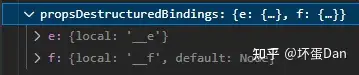
genDestructuredDefaultValue: 看名字就知道是用来获取解构赋值中的默认值的。
  function genDestructuredDefaultValue(key: string): string | undefined {
    const destructured = propsDestructuredBindings[key]
    if (destructured && destructured.default) {
      const value = scriptSetup!.content.slice(
        destructured.default.start!,
        destructured.default.end!
      )
      const isLiteral = destructured.default.type.endsWith('Literal')
      return isLiteral ? value : `() => (${value})`
    }
} helper: 前面也说过了,将runtime辅助函数存储到helperImport中。propsTypeDecl:defineProps使用only-type场景的类型定义。genRuntimeProps: 代码就不看了,简单的说下做了什么,里面会根据你的类型定义转化成runtime的props,毕竟浏览器不认识ts。另外还有个点我把代码贴出来
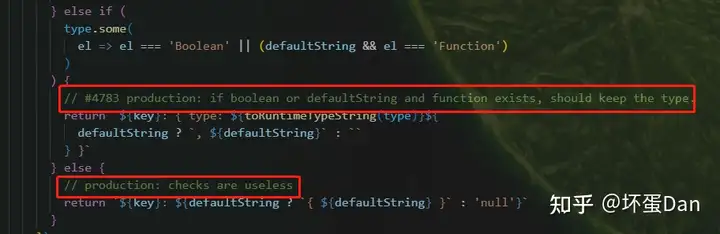
除了是boolean类型或者带有默认值的函数类型需要保留之外,其余的都会移除类型定义。
emitsRuntimeDecl: 同props。emitsTypeDecl: 同上。hasDefineExposeCall: 前面好像没说过?这个是判断是否用了defineExpose的,会被转换成export default对象中的expose()方法。defaultExport: 默认导出的,比如export { xx as default } from 'xx.js'。hasAwait: 是否有直接在setup block中使用await的,这个也是之前文章中提到好几次的,这里就不说如何处理这个场景的了,总之是允许你在setup语法糖下直接await而不需要async的。
这一大段看完代码估计大家都知道是在干啥了吧?
将之前的数据组装成非setup语法糖的样子,不多说,直接看数据。另外有个点就是之前的__default__,这里面包括non setup block的export以及别的包导入的比如export { x as default } from 'xx',最终都会合并到一起再export default导出。
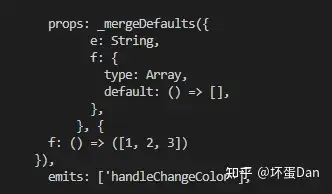
而最终转换的script代码由于太长,这里就直接以代码的形式贴出来。
import { c as __default__ } from "d.js";

import { a as _a, e } from "b.js";
import c from "d.js";
export { a as _a } from "b.js";

const aaa = [1, 2, 3];
var bbb = 555;
let ccc = bbb;
const ddd = defineProps({});
const hhh = _ref(0);

hhh.value = 666;

console.log(6666);
function iAmInNonSetupScriptBlcok() {
  console.log(666);
}

import Test from "./Test.vue";
import { ref, reactive, onMounted, onErrorCaptured } from "vue";

export default /*#__PURE__*/ Object.assign(__default__, {
  props: _mergeDefaults(
    {
      e: String,
      f: {
        type: Array,
        default: () => [],
      },
    },
    {
      f: () => [1, 2, 3],
    }
  ),
  emits: ["handleChangeColor"],
  async setup(__props, { expose, emit: emits }) {
    let __temp, __restore;

    _useCssVars((_ctx) => ({
      "xxxxxxxx-color": _unref(color),
    }));

    const testData =
      (([__temp, __restore] = _withAsyncContext(() => getData())),
      (__temp = await __temp),
      __restore(),
      __temp);

    const a = ref(0);
    const colorList = reactive(["#000", "#f00", "#0f0", "#00f", "#fff"]);
    const color = colorList[0];
    const b = reactive({
      c: 1,
      d: 2,
    });
    const input = ref(null);

    expose({
      input,
    });

    function handleChangeColor() {
      const { random } = Math;
      color.value = colorList(random() * 5);
    }
    onMounted(() => {
      a.value = 1;
      b.c = 2;
      b.d = 3;
      input.value.focus();
    });
    onErrorCaptured((err) => {
      console.log(err);
    });

    return {
      aaa,
      bbb,
      ccc,
      ddd,
      hhh,
      iAmInNonSetupScriptBlcok,
      emits,
      testData,
      a,
      colorList,
      color,
      b,
      input,
      handleChangeColor,
      _a,
      e,
      c,
      Test,
      ref,
      reactive,
      onMounted,
      onErrorCaptured,
    };
  },
});
这回一目了然了,感觉前面说的一堆解析还不如这里直接贴出来最终代码。
这里有几处地方你们应该注意到了
import的语句包括non setup script block中的import都会被移动到头部,也就是顶级作用域。export { x as default } from 'xx'或者non setup block中的export default都会被合并到__default__中,然后和我们的setup block中的export default合并组合成最终的export defaultsetup函数中return出去的东西是包括non setup block的defineExpose会被转换为expose方法defineProps、defineEmits等方法的import都被移除了,实际上并不需要开发者去导入。props、emits的定义都会被移到setup外部,这也就解释了为什么你在defineProps、defineEmits中引用local变量(setup函数中的变量)会报错了。props、emits、expose赋值给的变量都会被处理迁移到setup函数的参数中,上面埋下的坑这里补上了。setup block中直接使用await的会被处理成一个立即执行函数,具体怎么做之前的文章里有说。- 如果用了
await,这里setup函数会给你加上async。 css变量会被处理成一个带有scopedId的字段,然后在组件创建时执行,具体怎么做的,之前的文章里也有说到过了,这里就不多说了。$ref语法糖被处理成ref,连同xxx = aa被处理成xxx.value = aa。
加入辅助函数到源码中#
  // 12. finalize Vue helper imports
  if (helperImports.size > 0) {
    s.prepend(
      `import { ${[...helperImports]
        .map(h => `${h} as _${h}`)
        .join(', ')} } from 'vue'\n`
    )
  }
这个就不多说了,我们直接看下数据

这些都是runtime需要的辅助函数
这里面就mergeDefaults没说过,不过这个简单说就是合并默认值的操作。
返回最终数据#
  return {
    ...scriptSetup,
    bindings: bindingMetadata,
    imports: userImports,
    content: s.toString(),
    map: genSourceMap
      ? (s.generateMap({
          source: filename,
          hires: true,
          includeContent: true
        }) as unknown as RawSourceMap)
      : undefined,
    scriptAst: scriptAst?.body,
    scriptSetupAst: scriptSetupAst?.body
  }
没啥好说的。。。
总结#
今天是分析如何处理script的最后一天,我们终于看到了最终的代码长啥样了。
简单的说主要就是在将setup语法糖处理成非语法糖的样子,这里面最麻烦的就是props的处理了。。
参考#
发布于 2022-12-05 16:59・IP 属地广东